Introduction
The DataSapien Orchestrator serves as the central control hub for DataSapien Mobile SDK instances and functions as a powerful low-code/no-code management platform. It combines administrative functions (typically performed occasionally) with daily operational functions, enabling teams to configure, monitor, and deploy privacy-first data collection and personalization at scale—all from a single, intuitive interface.
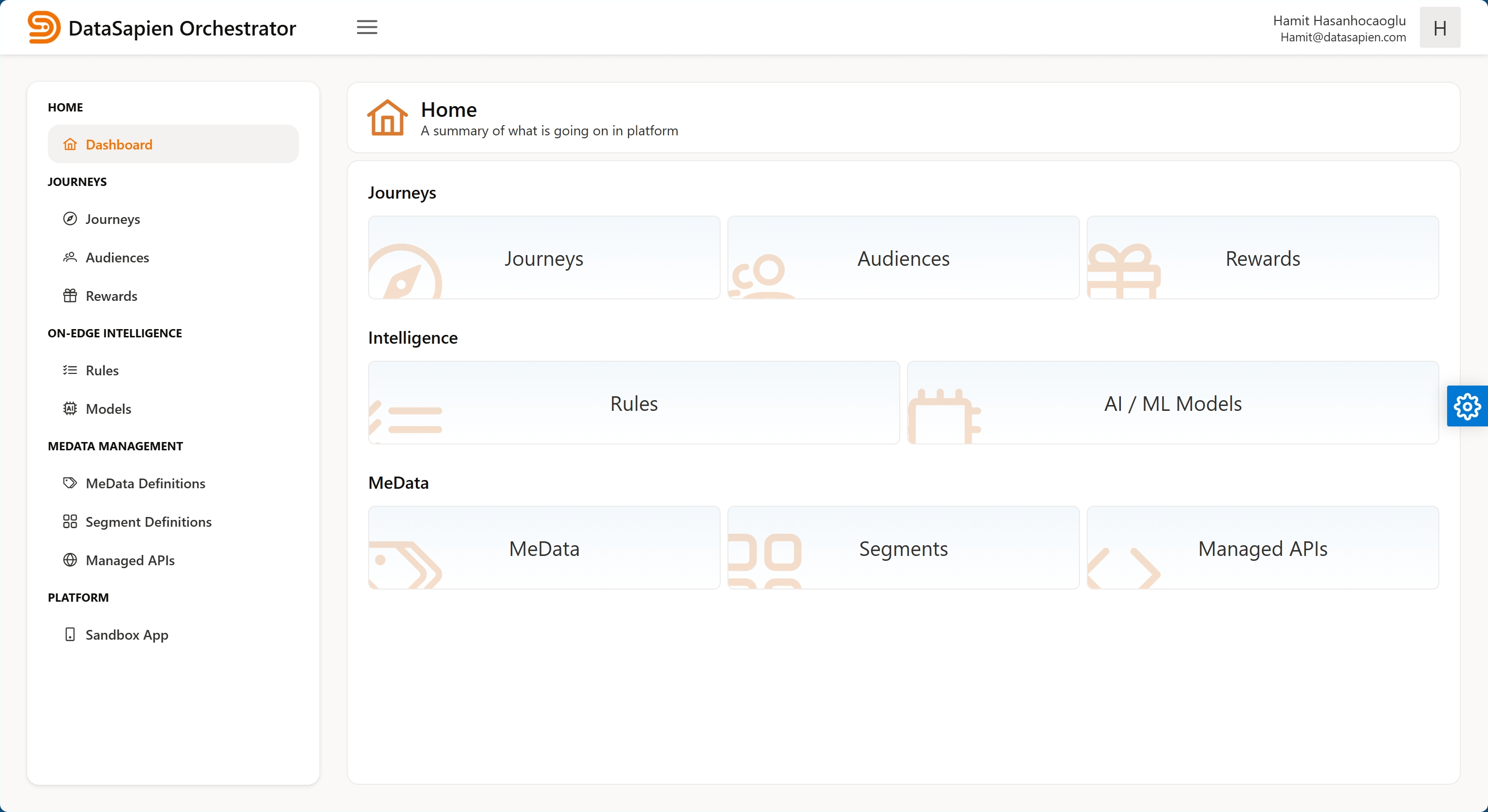
The Orchestrator Home page
Journeys
In contrast to occasional Administration functions, it is the daily operational functions that integrate the Orchestrator into daily buiness processes:
- Designing and deploying Journeys for selected Audiences.
- Creation / management of Audiences to target users based on their MeData.
- Creation and management of Reward types for users who choose to participate in targeted Audience.
- Viewing basic aggregations of Zero-Pary Data (ZPD) and generating essential reports based on Zero-Party Data accessed via Journeys.
Intelligence Management
The Orchestrator also enables management of on-device (edge) intelligence features within the Mobile SDK. These include:
- Designing and deploying Rules that define specific actions for the Mobile SDK to perform on the user’s device when MeData-based conditions are met.
- Provisioning ML/AI Models to be downloaded and executed on-edge by the Mobile SDK.
MeData Management
Since MeData is the main building block of the platform on which all other use cases are built, the Orchestrator provides functionality related to the definition and sources of MeData.
- Management of Managed APIs: Enables the integration of any web API (public or private) that is accessible from user devices as a source of MeData.
- Management of MeData Definitions: Allows you to design your data taxonomy and specify how MeData is collected from various sources, including the Managed APIs and Questions.
- Management of Segment Definitions: Enables the creation of atomic end-user segments based on individuals’ MeData, which can then be combined to form Audiences.